Loading...

Looking Beyond the Unemployment Rate

by Joseph Mayans 4 min read May 11, 2020

There is no doubt that there will be many headlines published about the latest Bureau of Labor Statistics (BLS) jobs report. The official unemployment rate spiked to 14.7%, the highest level since the Great Depression, and employers shed an unprecedented 20.5 million jobs. However, given the scale and pace that businesses around the country are adjusting their workforces, these headline numbers – especially the official unemployment rate – fall short in capturing the nuances and internal dynamics of the crisis.

To get a better picture of labor market health in the coming months, there are three other components reported in BLS’s employment release that require close attention: the underemployment rate, the labor force participation rate, and the employment-population ratio.

Tracking underemployment
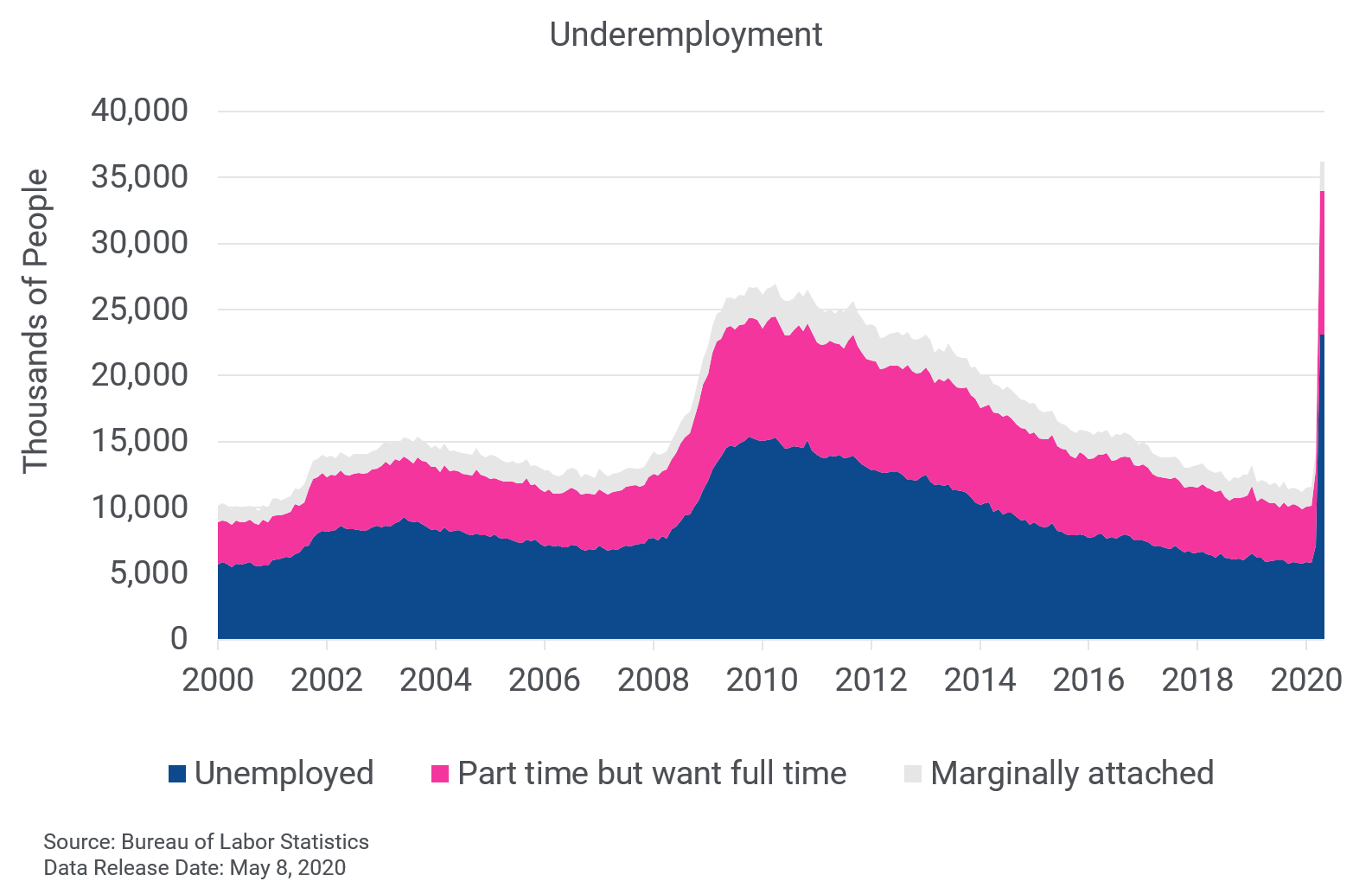
The BLS reports six unemployment figures in its monthly employment release, U1 – U6. The most cited is the “official” unemployment rate, which is U3. However, in the current crisis, the more salient measure of unemployment is U6, which is often known as the “underemployment” rate.

This is because the underemployment (U6) rate takes the unemployed and adds on part-time workers who want a full-time job (BLS calls this segment “part time for economic reasons”), plus marginally attached and discouraged workers (those who don’t think they can find work). Viewing the employment landscape through this lens provides greater insight into the pain points within the labor market.

In April, the underemployment rose from 8.7% to 22.8% – the largest jump on record. A large contributor to the rise was a doubling of the number of part-time workers that wanted a full-time job. Mirroring what happened in previous downturns, the rise in this segment was caused by employers downshifting workers into part-time roles. The official unemployment rate will miss this insight as it classifies everyone who is working as “employed”, regardless if they worked one hour or 100 hours.

Trends in the underemployment rate will be especially important to watch as the recovery gets underway. If employers are doubtful of a strong rebound, they may keep employees on as part time and forgo filling any full-time positions.
Who’s in and who’s out of the labor force

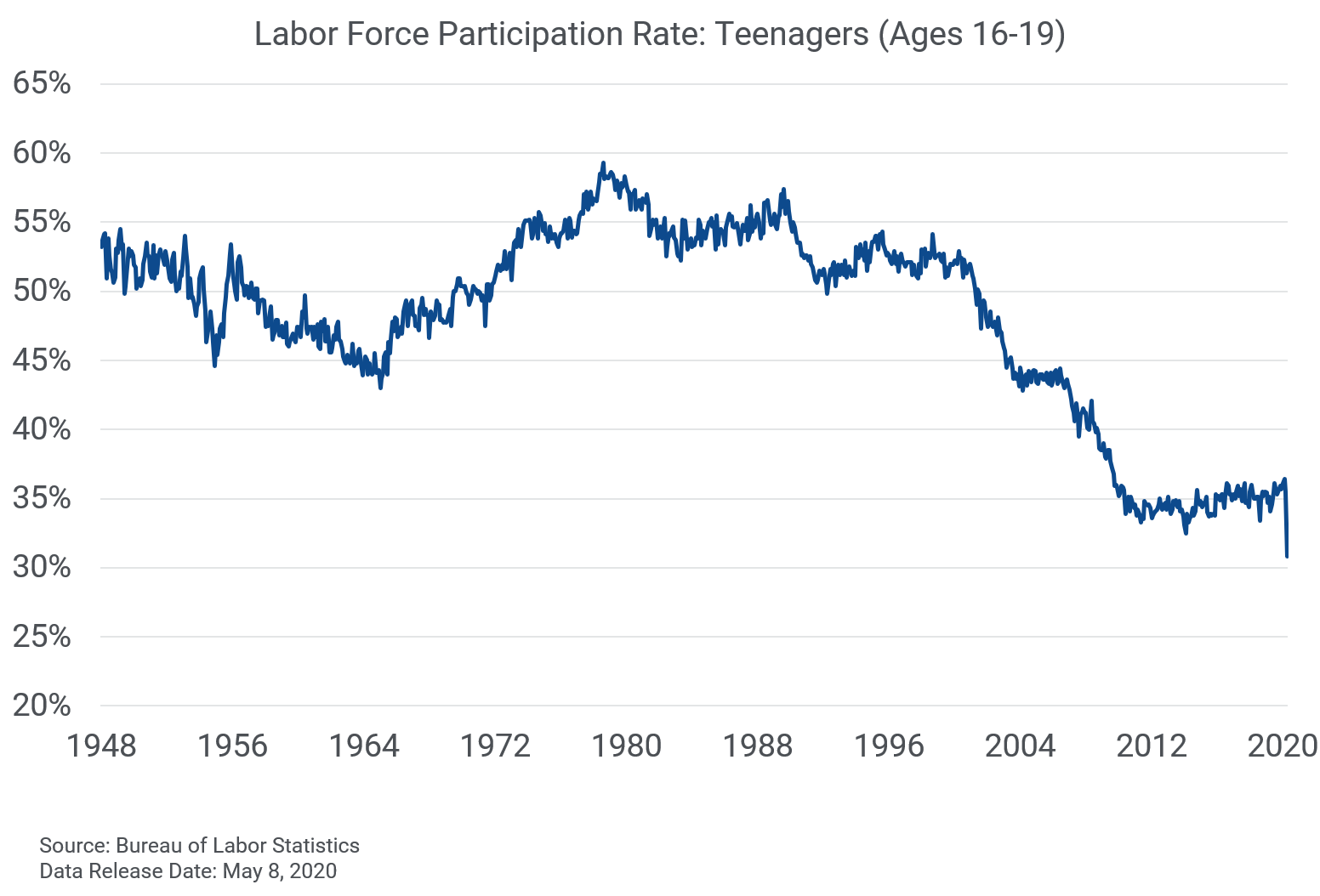
The labor force participation rate is the percentage of the working-age population (aged 16+) that is employed or searching for a job. A decline in the labor force participation rate means that people are leaving the workforce and are no longer looking for employment.

April’s employment report showed labor force participation declining from 62.7% to 60.2%. Teenage participation was especially hard hit, dropping from 35.5% to 30.8% – the lowest level since the government started collecting the data in 1948.

During the recovery phase, tracking what happens with labor force participation will provide insight into how potential workers perceive their chances of landing a job and if it is safe to return. A healthy (or improving) labor market will bring people off the sidelines in search of work, while a weak labor market will do the opposite.

Get a clearer view with the employment-population ratio

In the current environment where people are bouncing rapidly between employed, unemployed, underemployed, and out of the labor force, tracking the employment-population ratio provides a more stable baseline to view the economic environment.
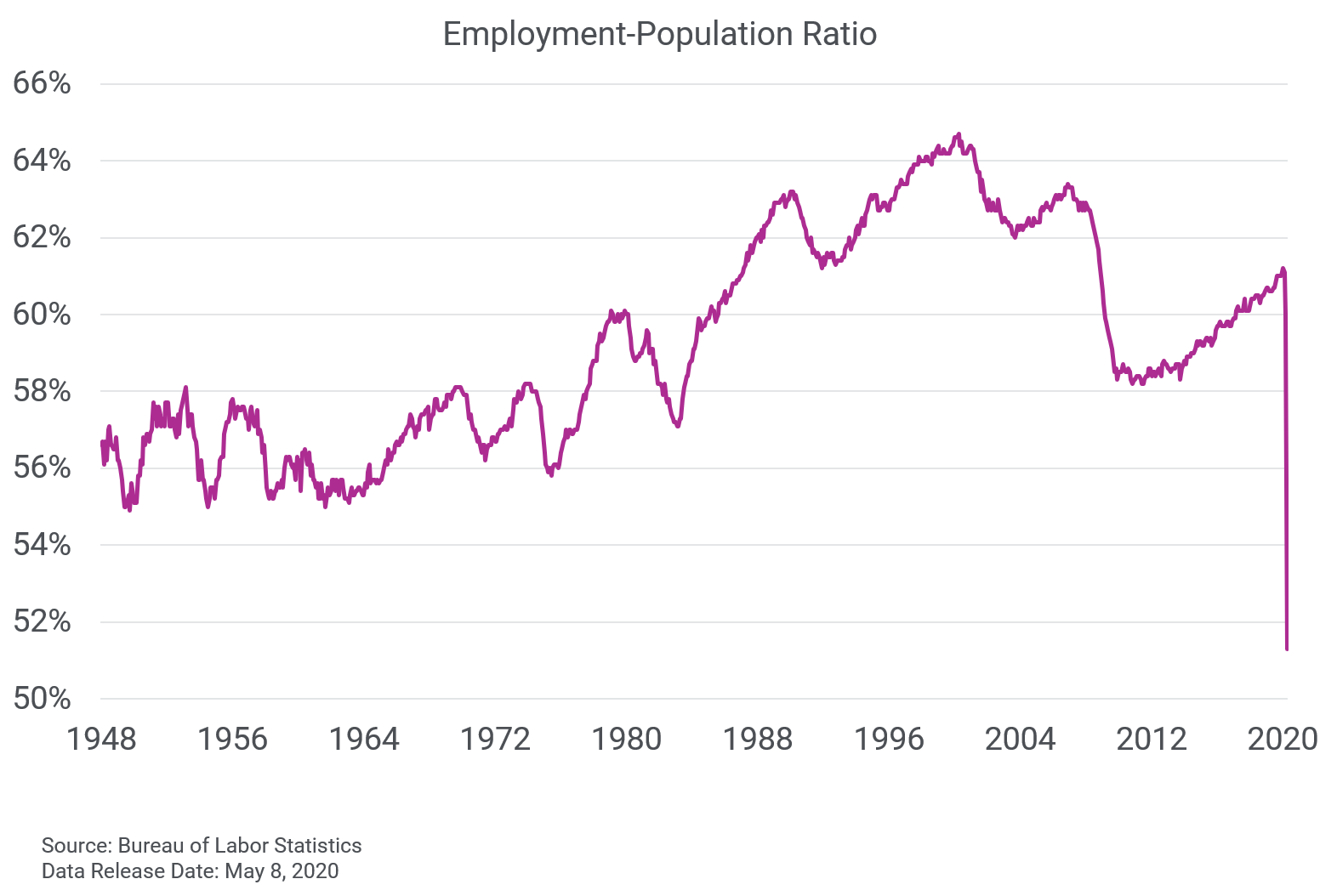
The latest data shows that the employment-population ratio dropped to the lowest level on record of 51.3% in April. This means that only half of people who are of working age in the U.S. are currently employed in some form.

Unlike the unemployment rate, which is calculated by dividing the number of unemployed workers by the labor force and thus subject to more variation as people start and stop looking for work, the employment to population ratio is the percentage of the total working-age population that is currently employed. By having a more stable baseline, it is easier to locate trends and see through the market gyrations.

And finally, why it matters

The labor market is the backbone of the economy and is the engine that powers the US consumer. But the ongoing crisis and rapid reallocation of the workforce has made it difficult to get a clear picture on what is happening at the ground level. By going beyond the headlines, businesses and financial institutions can glean nuanced insights that provide a better view of where the opportunities lie and how the recovery is likely to unfold.


Learn more

Related Posts

Financial services leaders are dealing with numerous pressures at the same time. These growing challenges for financial services organizations include sophisticated fraud, rapid Artificial Intelligence (AI) adoption without clear regulatory direction, rising customer expectations and the need for compliant, sustainable growth. Businesses are rethinking how they manage risk, growth and customer trust. These financial industry challenges are no longer confined to internal risk teams. They directly impact long-term customer loyalty. How organizations navigate these challenges will determine how effectively they deliver value to their customers. We’ve outlined the six challenges for financial services oranizations that consistently rank highest among industry leaders today. Challenge 1: Fraud is becoming harder to detect and eroding customer trust 72% of business leaders expect AI-generated fraud and deepfakes to be major challenges by 20261 As fraud tactics evolve quickly, driven in part by AI, customers are being targeted through identity-based attacks from account takeovers to synthetic identities and misuse of personal information. When these threats go undetected, or when legitimate activity is incorrectly flagged, the result isn’t just financial loss. It’s a breakdown of trust. Organizations that want to stay ahead must move beyond isolated fraud controls. By embedding identity management and monitoring into the customer experience, organizations can move from reactive fraud response to proactive identity protection. Identity theft protection and monitoring help organizations turn fraud prevention into a visible, trust-building experience for customers — offering early alerts, guidance, and peace of mind when identity risks arise. Challenge 2: AI decisions must be trusted by customers, not just regulators 76% of businesses say implementing responsible AI is one of their biggest challenges2 As AI becomes more embedded in financial services, it shapes the experiences customers see every day. From credit decisions to eligibility outcomes and personalized offers. While AI can drive faster and more inclusive decisions, it also introduces a new expectation: customers want to understand why a decision was made. Responsible AI is no longer just about regulatory compliance. It’s about delivering outcomes that feel fair, consistent and easy to understand. When decisions appear unclear, confidence erodes. When organizations can clearly explain outcomes, not just internally, they build confidence across regulators, partners and customers. This allows AI to scale responsibly while reinforcing trust in every interaction. Financial wellness tools such as credit scores, reports and education help make AI-driven decisions more transparent, giving customers clarity into outcomes and confidence in how their financial health is assessed. Challenge 3: Digital experiences are failing to deliver clarity and confidence 57% of U.S. consumers remain concerned about conducting activities online3 Customer confidence is affected by day-to-day interactions such as onboarding, payments and issue resolution. Inconsistent decisions, unclear outcomes and friction in digital journeys can quickly erode confidence and increase confusion, disengagement and abandonment. Financial services leaders will need to rebuild and strengthen confidence. Improving key decision points with better data and analytics helps ensure customers receive timely insights, understandable outcomes and meaningful guidance, turning everyday interactions into opportunities to build stronger relationships. By delivering ongoing financial wellness insights and education, organizations can replace confusion with clarity — helping consumers better understand their financial standing and stay engaged over time. Challenge 4: Gen Z continues to raise the bar It's no secret that Gen Z stands out for its strong preference for digital financial services and digital interactions, but Gen Z is also pushing the envelope on financial wellness. 48% of Gen Z report that they do not feel financially secure, indicating strong demand for financial support and tools4 Their expectations for instant decisions, seamless digital experiences, transparency and tools that help them manage their financial lives are quickly becoming the baseline. To meet and exceed these expectations, financial institutions will need to support real-time, data-driven decisioning that adapt to individual needs. Delivering modern, app-like financial experiences, without compromising risk management. Increasingly, organizations are meeting Gen Z expectations by offering financial wellness and protection tools through employee benefits, supporting everyday financial confidence beyond traditional compensation. Challenge 5: Limited data limits meaningful consumer engagement 62 million U.S. consumers are thin-file or credit invisible under traditional credit scoring.5 Growth will always be a priority, but it must be responsible and inclusive. Traditional credit data alone often provides an incomplete picture of consumer financial behavior, limiting visibility and making it harder to confidently expand access. By incorporating alternative and expanded data, organizations can gain a more holistic view of consumers. This broader perspective supports smarter decisions, personalized insights and more inclusive engagement, which enables growth while maintaining compliance and managing risk responsibly. Expanded data supports more personalized financial wellness experiences, enabling organizations to provide relevant insights, responsible access and guidance tailored to individual consumer needs. Challenge 6: Disconnected decisions create inconsistent customer experiences Increasingly, fintech leaders are moving toward unified risk and decisioning strategies to deliver more personalized experiences6 While customers interact with a single institution, decisions are often made across disconnected data sources, systems and teams. These silos create inconsistent experiences, slow responses and operational complexities that customers feel directly through conflicting messages and uneven outcomes. Experian helps organizations break down these silos by unifying data, analytics and decisioning across the enterprise. When data incidents occur, integrated experiences enable faster data breach resolution, helping consumers understand what happened, take action, and recover with confidence. Looking ahead These challenges for financial services organizations are not emerging; they’re already here and reshaping how financial institutions engage with consumers. Leaders who proactively address financial industry challenges by connecting data, analytics, and responsible AI are better positioned to deliver trusted, transparent and meaningful experiences. Learn More References:1. https://www.experian.com/blogs/insights/2025-identity-fraud-report2. https://www.techradar.com/pro/businesses-are-struggling-to-implement-responsible-ai-but-it-could-make-all-the-difference3. https://www.experian.com/blogs/insights/2025-identity-fraud-report4. https://www.deloitte.com/global/en/issues/work/genz-millennial-survey.html5. https://www.experian.com/thought-leadership/business/the-roi-of-alternative-data6. https://us-go.experian.com/2025-state-of-fintech-report?cmpid=IM-2025-state-of-fintech-report-livesocial-share

by Zohreen Ismail 4 min read February 9, 2026

Executive Summary The July 2025 housing market reveals a landscape of shifting consumer behaviors, evolving lender strategies, and continued strength in borrower performance—especially within home equity. Origination volumes have dipped slightly, but direct marketing, particularly through Invitation to Apply (ITA) campaigns, is accelerating. As key players exit the space, gaps are opening across both marketing and origination, creating clear opportunities for agile institutions. This phase signals both caution and potential. The winners will be those who refine their marketing, sharpen segmentation, and deploy smarter risk monitoring in real time. TL;DR Risk Profile: Mortgage and HELOC delinquencies remain low. Slight increases in 90+ DPD are not yet cause for concern. Mortgage Originations: Modestly down, but marketing remains aggressive. Invitation to Apply (ITA) volumes outpacing prescreen. Home Equity Originations: Stable originations, competitive marketing volumes. ITA volumes outpacing prescreen similar to mortgage. Opportunity: Targeted direct mail and refined segmentation are growth levers in both mortgage and home equity. Risk Environment: Resilient Yet Watchful Experian’s July data shows both mortgage and home equity delinquencies hovering at historically low levels. Early-stage delinquencies dropped in June, while late-stage (90+ days past due) nudged upward—still below thresholds signaling broader distress. HELOCs followed a similar path. Early-stage movement was slightly elevated but well within acceptable ranges, reinforcing borrower stability even in a high-rate, high-tariff environment. Takeaway: Creditworthiness remains strong, especially for real estate–backed portfolios, but sustained monitoring of 90+ DPD trends is smart risk management. Home Equity: Volume Holds, Competition Resets Home equity lending is undergoing a major strategic reshuffle. With a key market participant exiting the space, a significant share of both marketing and originations is now in flux. What’s happening: Direct mail volumes in home equity nearly match those in first mortgages—despite the latter holding larger balances. ITA volumes alone topped 8 million in May 2025. Total tappable home equity stands near $29.5 trillion, underscoring a massive opportunity.(source: Experian property data.) Lenders willing to recalibrate quickly can unlock high-intent borrowers—especially as more consumers seek cash flow flexibility without refinancing into higher rates.   Direct Mail and Offer Channel Trends The continued surge in ITA campaigns illustrates a broader market pivot. Lenders are favoring: Controlled timing and messaging Multichannel alignment Improved compliance flexibility May 2025 Mail Volumes: Offer Type Mortgage Home Equity ITA 29.2M 25.8M Prescreen 15.6M 19.0M Strategic Insights for Lenders 1. Invest in Personalized Offers Drive better response rates with prescreen or ITA campaigns. Leverage data assets like Experian ConsumerView for ITA’s for robust behavioral and lifestyle segmentation. For prescreen, achieve pinpoint-personalization with offers built on propensity models, property attributes, and credit characteristics. 2. Seize the Home Equity Opening Use urgency-based messaging to attract consumers searching for fast access to equity—without the complexity of a full refi. Additionally, as mentioned above, leverage propensity, credit, and property (i.e. equity) data to optimize your marketing spend. 3. Strengthen Risk Controls Even in a low-delinquency environment, vigilance matters. Account Review campaigns, custom scorecards, and real-time monitoring help stay ahead of rising 90+ DPD segments. 4. Benchmark Smarter Competitive intelligence is key. Evaluate offer volumes, audience segmentation, and marketing timing to refine your next campaign. FAQ Q: What does the exit of a major home equity player mean? A: It leaves a significant gap in both marketing activity and borrower targeting. Lenders able to act quickly can capture outsized share in a category rich with equity and demand. Q: How should lenders respond to the evolving risk profile? A: Continue to monitor performance closely, but focus on forward-looking indicators like trended data, income verification, and alternative credit signals. Conclusion The housing market in July 2025 presents a clear message: the fundamentals are sound, but the strategies are shifting. Those ready to optimize outreach by making smarter use of data will seize a disproportionate share in both mortgage and home equity. Want to stay ahead? Connect with Experian Mortgage Solutions for the insights, tools, and strategies to grow in today’s evolving lending environment.  

by David Fay 4 min read August 29, 2025

Understanding generational trends and preferences is more crucial than ever, especially for the financial services industry.

by Josee Farmer 4 min read June 24, 2025